
Animal Directory Featured species in the planned Aquarium & Marine Realm habitat
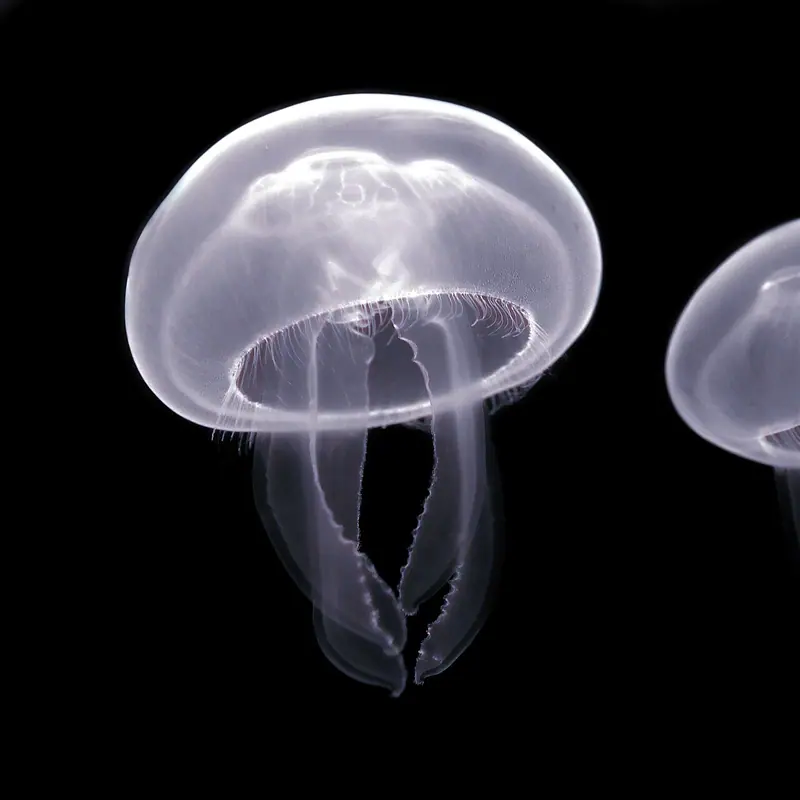
Photo: Luc Viatour CC BY-SA 3.0 Wikimedia Commons
Moon Jellyfish
Aurelia aurita
Young Explorer Notes
Three quick things to know about the Moon Jellyfish.
- Superpower
Roughly 95% water, with no brain, no blood, no bones, and no heart — yet still hunts, reproduces, and migrates daily …
- Home
Shimmering tanks and tunnels under the sea.
- How to help
Doing great in the wild!
Scientists say this species is safe for now. We still learn about them to keep it that way.
Fun facts for everyone
- Roughly 95% water, with no brain, no blood, no bones, and no heart — yet still hunts, reproduces, and migrates daily through the water column.
- The four pale horseshoes visible through the bell are gonads, not eyes or organs — the body is otherwise translucent.
- Stinging cells are too weak to break human skin, which is why moon jellies are the species used in nearly every public aquarium display.
- Has a life cycle that alternates between a free-swimming medusa and a stationary polyp; a single polyp can clone itself into hundreds of medusae.
- IUCN lists the species as Least Concern; it is so widely distributed and so adaptable that it thrives in nutrient-polluted coastal waters where many other species fail.
From the master plan
The Moon Jellyfish is the planned Aquarium & Marine Realm’s sensory pause — a backlit kreisel tank in a side gallery, soundtrack soft, lit in the cool blues and lavenders that make the bells glow. It’s the exhibit guests linger at longest.
IUCN status sourced from the Moon Jellyfish (Aurelia aurita) assessment (2014) on the IUCN Red List — listed as Least Concern with a wide, stable global distribution.
Find them in